When the score matters, it’s easy to stop trusting your golf swing and start guiding the club like it’s carrying a glass of water. One poor shot becomes three swing thoughts, a tight grip, and a ball you tried to “place” down the fairway.
Trust is not a feeling you wait for. It’s a decision to finish your routine, choose the shot, and swing before doubt gets another vote.
Watch for these pressure leaks:
- A slower backswing after a bad hole
- Technical thoughts creeping in over the ball
- Trying to steer the ball away from trouble
Commit to the shot. Let the swing go.

What Trusting Your Swing Really Means
To trust your golf swing is not to stand there hoping today’s version of your swing shows up. It’s letting a trained motion happen without jumping in at the last second to rescue it.
That’s a different standard than most golfers use.
A lot of players treat trust like a feeling. If they feel loose, positive, and confident, they say they trust it. If they feel tight or uncertain, they assume trust is gone. We don’t see it that way. Golf trust under pressure is a skill, not a mood.
At its core, trust is built from three things:
- attention control
- emotional control
- commitment
If your attention stays on the shot, your emotions don’t run the show, and your decision is final, you can make a committed swing even when you don’t feel amazing.
That’s the part golfers miss. You do not need to feel great about your swing to commit to the shot in front of you. In fact, some of the best swings you’ll make on the course will happen on days when your swing confidence golf feels shaky, but your decision-making is clean.
There’s also a useful distinction here. Trusting your swing matters, but trusting yourself matters more. Your swing is never perfect. Your ability to follow a repeatable process under pressure is much more stable. When players say they want more golf confidence, what they usually need is more trust in their own process.
Trust is often expressed through action before it ever feels comfortable.
Positive thinking has its place, but it won’t carry you very far if your mind is noisy and your routine is weak. Real trust looks more like discipline than inspiration.
Why Trust Disappears When the Pressure Rises

Most golfers know the pattern because they’ve lived it.
One bad shot creates a little fear. Fear pulls you into control mode. You start adding technical instructions. The swing gets tight, careful, and late. Then you hit another poor shot, which seems to prove you were right not to trust it.
That cycle is brutal because it feels logical in the moment.
Pressure also narrows attention, but not in a helpful way. Instead of seeing the target and the task, your mind starts bouncing between mechanics, consequences, and self-judgment. One second you’re thinking about the fairway. The next you’re thinking, “Don’t leave the face open. Don’t get quick. Don’t hit the block again.”
That is too much traffic for one swing.
On the range, you can get away with it for a while. You have repetition, rhythm, and almost no consequence. On the course, every shot changes. Different lie, different target, different club, actual score attached. That’s where dependence on conscious control gets exposed.
You’ll recognize the behaviors:
- decelerating through impact
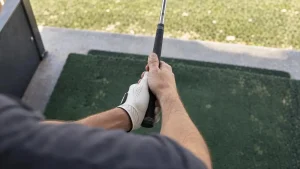
- guiding the club instead of releasing it
- holding on with the hands
- trying to stop steering the golf ball halfway through the motion
- taking forever over the ball, then swinging with zero freedom
Pressure doesn’t always reveal a lack of ability. Very often it reveals that your game still depends too much on monitoring and control.
And control feels safe right up until it wrecks your tempo.
The Real Enemy Is Not Nerves, It Is Interference
Nerves are normal. If the shot matters, your body should notice.
We’d be more concerned if you felt nothing on a shot that actually counts.
The issue is not that adrenaline shows up. The issue is what you do next. Many golfers lose access to their natural motion because they respond to nerves by interfering with the swing. They feel tension and immediately decide tension means something is wrong.
It doesn’t.
There’s a big difference between feeling nervous and swinging like a nervous person. Emotional control is not about becoming calm. It’s about staying functional. Clear enough to choose. Steady enough to commit. That’s a better target than trying to feel peaceful on the 17th tee.
A useful shift:
- feeling tension is fine
- acting from tension is the problem
Golf confidence works the same way. It is not certainty. It is the ability to stay with a process when certainty is unavailable. That’s much more realistic, and frankly much more useful, than waiting to feel bulletproof.
We tell players this all the time: you don’t need less adrenaline, you need less interference.
Why the Range Swing Often Fails to Transfer to the Course
The range is your workshop. The course is where you use what you’ve built.
Those are not the same environment, and golfers get in trouble when they treat them like they are.
If you hit 20 balls in a row with the same 7 iron to the same flag, you can get comfortable fast. But comfort is not the same as trust. Repetition builds familiarity. It does not automatically build performance.
Trust grows when practice includes:
- a specific target
- a real decision
- a full routine
- some consequence if you don’t pull it off
Many golfers are mechanically good enough to score better right now. What’s missing is not more swing knowledge. It’s the ability to perform without supervising every move.
This shows up most clearly in feel-based skills. Distance control, tempo, and rhythm tend to fall apart first when conscious control takes over. That’s why a player can stripe balls on the range, then get on the course and leave wedge shots short, guide putts, or make a full swing that feels like a half swing.
A few poor transfer habits do a lot of damage:
- hitting ball after ball without changing clubs
- skipping the pre-shot routine in practice
- judging success only by contact
- taking range swing thoughts straight to the first tee
That’s not performance practice. That’s mechanical comfort.
And mechanical comfort disappears quickly once the card matters.
Trust Starts With Separating Practice Mode From Play Mode
Mechanics matter. Just not during execution.
Too many golfers try to coach themselves while they play. That usually leads to slower decisions, more doubt, and less athletic motion. You’re asking the same brain to diagnose, fix, and perform inside a few seconds. That’s asking for noise.
A cleaner model is this:
Practice mode
Practice mode asks: how do I move?
This is where you work on positions, patterns, feels, and technical change. You can film the swing, exaggerate a move, and stop to reflect.
Play mode
Play mode asks: what is the shot, and can I fully commit to it?
Once you’re on the course, the job changes. You’re no longer building a swing. You’re using one. That means your thinking has to get simpler, not smarter.
If you need a cue in play, keep it very small. One feel. One action. Maybe smooth tempo. Maybe full finish. Maybe soft shoulders. Not five body parts and a takeaway checkpoint.
Trust your golf swing does not mean ignoring technique. It means protecting performance from technical overthinking.
Disciplined thinking is part of golf confidence. Players who think clearly under pressure usually swing more freely, not because they are fearless, but because they know what belongs in the moment and what doesn’t.
Build a Pre-Shot Routine That Creates Trust in Yourself
If there is one place to build trust on purpose, it’s your pre-shot routine.
A good routine gives your mind and body something repeatable to do under pressure. It reduces indecision. It marks the moment when analysis ends and execution begins. And it gives you something to trust besides your feelings.
We like to keep it simple and consistent:
- Assess the shot.
- Choose a target and a shot shape you genuinely believe you can hit right now.
- Make that decision final.
- Rehearse the feel once or twice.
- Step in and go.
That middle section matters more than golfers think. Choose a shot you actually believe in, not the hero version you wish you had. Under pressure, honesty helps more than ambition.
It also helps to divide the routine into a think box and a play box. Behind the ball, you can analyze. Over the ball, you perform. Elite players are very disciplined here. Some even keep their routine length remarkably steady from shot to shot. That is not a personality quirk. It keeps the mind from drifting.
A couple of details are worth using:
- visualize the full shot, not just the start line
- feel the intended motion before you step in
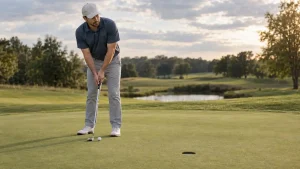
- use a brief target gaze before you pull the trigger, especially on wedges and putts
That last one is underrated. A short, clear look at the target helps organize intention. It gets you out of self-monitoring and back into performance.
If you want to commit to golf shots, your routine has to make commitment easier.
What a Small Breathing Study Found
A 2026 within-subject experiment tested a pre-shot routine with slow-paced breathing in 15 male golfers ages 18–30. The breathing version used roughly 4–6 breaths per minute and was compared with a standard pre-shot routine across three conditions, including pressure. It produced significantly higher heart-rate-variability scores (RMSSD) and lower heart-rate responses than the routine alone (p < .05). The study also found a useful caution: under pressure, golfers hit the ball farther with the breathing routine but showed greater lateral deviation than in the non-pressure condition.
That makes breathing a possible reset tool, not a guarantee of a better shot. Use it to arrive at the ball with a clearer state, then keep the play-box job simple: choose the target, make the decision, and swing. The study was acute and small, so it cannot show that this approach will improve scoring or accuracy over a full round.
How to Commit to a Shot When Your Swing Does Not Feel Good
This is where a lot of rounds get lost.
Golfers often assume that if the swing doesn’t feel good, commitment is fake. That’s wrong. Commitment and swing satisfaction are not the same thing. You can feel uncertain and still make a very good competitive swing.
Even elite players win when parts of their game feel off. What they do well is commit to the task in front of them rather than waiting for perfect feel to return.
When your swing feels shaky, choose one simple action goal that you can actually do. For example:
- hold the finish for three seconds
- relax the shoulders
- make a smooth tempo swing
- see the target clearly
- feel the core stay engaged
These are useful because they support motion. They are not emergency repair jobs.
A good cue is doable under pressure. A bad cue sends you deeper into mechanics.
There’s another hard truth here. On days when your swing feels off, shot selection has to get more honest. Hit the shot that matches your current ability and confidence, not the one that flatters your ego. Practical golf confidence is often quieter than people want. It doesn’t always look bold. Sometimes it looks like choosing the center of the green and swinging with full commitment.
That’s still trust.
A Step-by-Step Process to Trust Your Golf Swing Under Pressure

When the heat rises, you need a process you can run without negotiating with yourself.
Use this:
On-shot routine
- Acknowledge pressure
Notice the pressure without fighting it.
- Define the shot
Name the shot and target clearly.
- Commit fully
Make one final decision about club, shape, and intention.
- Pick one cue
Choose one simple cue if needed.
- Rehearse
Rehearse briefly.
- Step in and swing
Step in with a quiet mind and execute without delay.
- Let it go
Accept the result and move on.
The timing matters. Once the decision is made, don’t stand there and reopen the case. The longer you wait after the final decision, the more likely doubt sneaks back in.
This is especially useful on:
- tee shots when score enters the picture
- approach shots late in the round
- short-game shots right after a mistake
Different players will apply it a little differently. Competitive players usually need tighter discipline around pace and routine. Recreational golfers often need simpler decisions and fewer cues. Better players often need help accepting imperfect feel without launching into constant fixes.
But the structure holds across levels. Clear decision. Short gap. Full commitment.
That’s how you stop steering the golf ball before it starts.
How to Stop Steering the Golf Ball
Steering is trying to guide the club or ball to safety during the swing instead of making a free motion.
It usually feels careful. And careful is rarely good in golf.
Common signs include slowed tempo, tight grip pressure, a held-off release, deceleration through impact, or that strange sensation that you’re trying to help the ball stay in play mid-swing. We’ve all seen it. Some players live there under pressure.
The causes are mostly mental:
- playing not to miss
- fear of outcome
- distrust after a recent mistake
- too much mechanical thought too late in the routine
The corrections need to match that reality. Start here:
- commit to a full finish
- use a tempo cue instead of a position cue
- pick a smaller, clearer target
- accept the possibility of a miss before starting the swing
- focus on the shot shape or flight, not body parts
That last point matters. If your mind is on the flight, your body has a better chance to organize itself. If your mind is on preventing disaster, the swing usually gets strangled.
Trying to control outcome too tightly tends to ruin both freedom and face control. That’s the ugly irony.
Practice Drills That Build Trust Instead of Just Technique
Trust is trained. It does not suddenly appear on the first tee because you want it to.
So practice has to look more like golf.
On the range, do more of this:
- change clubs often
- pick a specific target every time
- go through your full routine for every ball
- give each shot a consequence
One-ball practice is especially good. Hit one driver, one wedge, one mid iron. Different task every time. That’s closer to real play than raking and firing ten in a row.
For performance sessions, judge the rep by decision quality and commitment more than perfect contact. A flushed shot with a sloppy decision teaches the wrong lesson.
Short game deserves the same standard because trust often breaks down there first. Use:
- distance-control ladders with one attempt per station
- one-read, one-roll putting practice with full routine
- wedge practice to changing yardages instead of repeating one number
After practice, spend two minutes reviewing:
- which shots felt fully committed
- where steering showed up
- which cue helped most
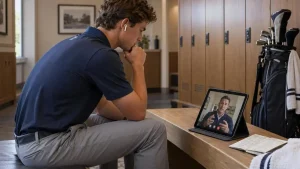
If you want more structure around this, online golf mental coaching can help build weekly practice exercises that carry directly onto the course. Some players need that extra layer because left alone, they drift back into mindless range habits pretty quickly.
What to Do Right After a Bad Shot
Your response to the last shot affects your ability to trust the next one.
Great players recover faster not because they don’t care, but because they don’t keep assigning meaning to every mistake. One bad swing does not require a new swing.
A simple recovery sequence works well:
After a bad shot
- Feel it
let the emotion move through instead of pretending it isn't there
- Reset
reset your breathing or posture
- Review briefly
do a brief factual review if needed
- Move on
shift fully to the next task
Keep that review short. Factual, not dramatic. “Started right.” “Too much club.” Fine. Then move on.
The two traps are obvious once you know them. First, carrying anger and fear into the next shot. Second, trying to fix mechanics immediately during the round. That second one gets players all the time. One mistake, then three holes of self-coaching.
Composure is trainable. In our work with golfers, this ends up being one of the biggest separators over 18 holes. Staying composed after mistakes usually matters more than trying to feel perfect.
Common Mistakes Golfers Make When Trying to Trust Their Swing
A few mistakes show up again and again, even in good players.
- trying to trust a shot they haven’t fully decided on
- confusing trust with passivity and just hoping it works
- carrying too many swing thoughts into pressure
- waiting for certainty before committing
- rushing after a bad shot or dragging things out on an important one
- taking technical drills straight into competition
- practicing mechanics without training decision-making
- assuming low trust means weak character
- changing routine, strategy, and self-talk all at once after a rough stretch
The biggest one? Looking for trust as a feeling instead of building it as a behavior.
If you commit well, think clearly, and stay composed, trust starts to show up. Not always in a dramatic way. Usually in a quieter, more professional way.
How Different Golfers Can Apply This Advice
The principles are the same across levels. The pressure just changes shape.
Competitive juniors and college players usually need routines that survive team pressure, score pressure, and ranking pressure. They also need to stop tying identity to results. A post-round review of commitment quality helps a lot here.
Elite amateurs and professionals tend to need help staying precise without becoming mentally crowded. Late in rounds, decision clarity gets more valuable than one more swing thought.
Recreational golfers often improve fastest by reducing clutter. Simpler targets, more realistic shot patterns, less mid-round fixing. Score matters, of course. But if you only measure progress by score, you’ll miss the actual skill you’re trying to build.
Different level, same truth: clear decisions travel.
When Self-Help Stops Working
Some golfers understand all of this the moment they read it and still can’t apply it when they compete. That’s not unusual.
If you deal with chronic steering under pressure, a strong range game that never transfers, emotional reactions that last for holes, or constant second-guessing over the ball, it may be time for more direct support.
That’s where online golf mental coaching can make sense. Done well, it gives you a clear plan, live guidance, and weekly on-course exercises built around your patterns, not generic advice. For golfers who want to test the fit first, a 30 minute trial session is a sensible starting point.
Not because you need motivation. Usually because you need structure.
Conclusion
To trust your golf swing is not blind faith. It’s a trainable performance skill built on clearer decisions, steadier emotions, and better commitment.
The goal is not to feel perfect. The goal is to stop interfering with the swing you’ve prepared.
Start with one change this week. Tighten your pre-shot routine. Use one simpler cue. Practice more like you play. Any of those will move the needle.
And if you want help building this into your actual golf instead of just understanding it in theory, online golf mental coaching or a 30 minute trial session can be a useful next step.